Albanian Coffee Culture: A Guide to a National Ritual
Coffee in Albania is less a beverage than a way of life. The country has one of the highest densities of coffee shops per capita in the world — around 650 per 100,000 inhabitants — and “let’s go for a coffee” (të pimë një kafe) is the unit of measurement for almost any social interaction: a first date, a business deal, a casual reunion, a long Sunday morning. After almost four years here, I can confirm: you can absolutely fill an afternoon doing nothing but moving from one café to the next, and locals will think you’re settling in nicely. Here’s how Albanian coffee culture actually works.
The short version – Coffee shops per capita: ~650 per 100,000 people — among the highest on earth – Two main styles: kafe turke (Turkish-style) and ekspres (Italian espresso) – Cost: €0.50–1.20 for a standard espresso, even in nice cafés – Order like a local: “Një makiato, ju lutem” — one macchiato, please – The rule: never rush a coffee. It’s not about caffeine; it’s about time.
Why coffee matters so much here
Coffee in Albania is the infrastructure of social life — the equivalent of the British pub. People meet over coffee to do business, to flirt, to argue politics, to make peace, to gossip about neighbours, to just sit. Older Albanians can stretch a single espresso into a two-hour conversation. Avash-avash — slowly, slowly — is a national rhythm that the café enforces.
This is partly Ottoman heritage (coffee arrived in the region in the 1500s and never left), partly Italian influence (espresso became dominant after the 1990s, especially in cities), and partly geography — Albania is small, walkable, and built around the xhiro, the evening promenade where families and friends stroll the pedestrianised centre and stop at cafés as they go.
You’ll find more cafés in any direction than you can possibly visit, especially in Tirana, Durrës, Vlorë, Shkodër and Korçë — corners of intersections where four cafés face each other isn’t unusual.
The two styles of Albanian coffee
There’s no single “Albanian coffee.” Locals drink two distinct traditions, often in the same day:
Kafe turke (Turkish-style coffee)
The older tradition, inherited from the Ottoman era and shared across the Balkans. Finely ground coffee is boiled with water (and usually sugar) in a small long-handled copper pot — an ibrik or xhezve — and served unfiltered. The grounds settle at the bottom; you sip the strong, dark, slightly thick liquid above them.
How to order it by sweetness:
- E ëmbël (eh-MB’l) — sweet, with plenty of sugar
- E mesme (eh MESS-may) — medium
- Pa sheqer (pah she-KEHR) — no sugar
Always served with a small glass of water. Don’t drink the last sip — the grounds are bitter. Older Albanians sometimes read the grounds left in the cup, a folk fortune-telling tradition called fall kafeje.
Ekspres (Italian espresso)
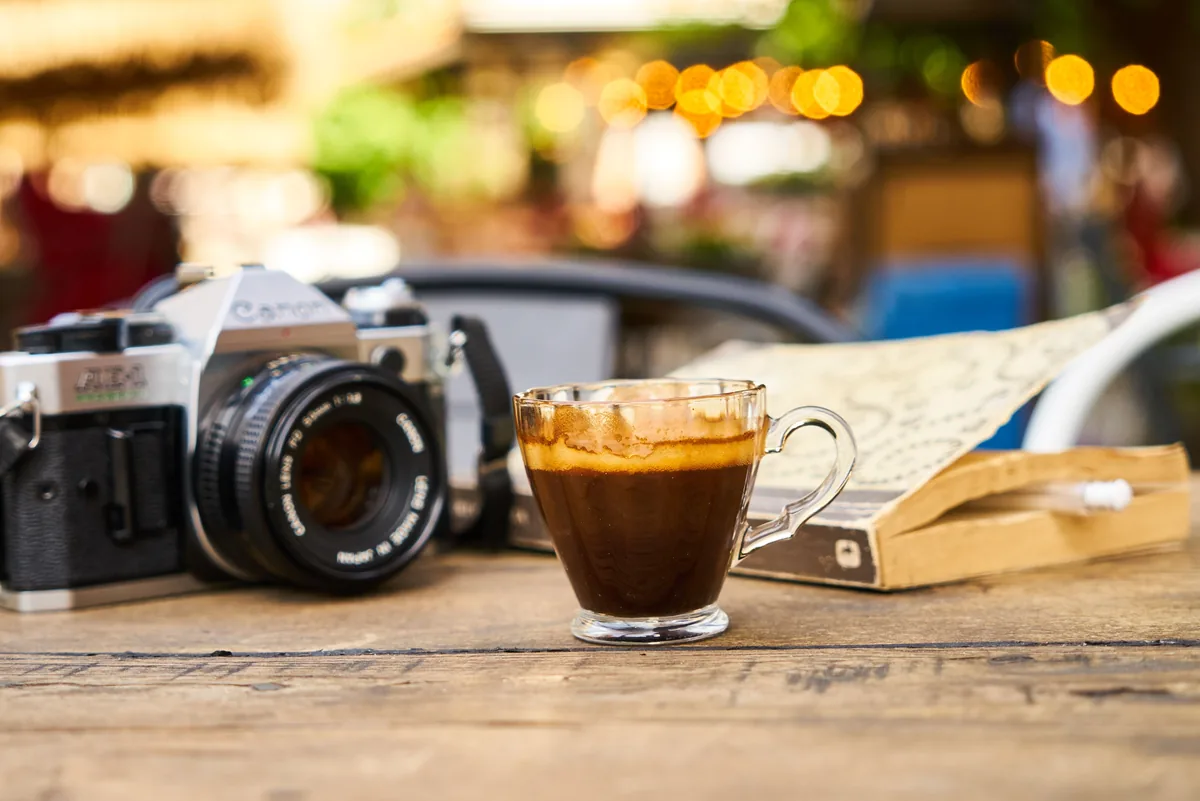
The modern default in city cafés. A small, intense shot, served exactly as in Italy — usually for 50–80 lek (about €0.50–0.80). The drinks menu mirrors the Italian one:
- Ekspres — a straight espresso
- Ekspres i gjatë (lit. “long espresso”) — a longer pull, like an Americano
- Makiato — espresso macchiato (espresso with a touch of milk foam) — the most ordered drink in Albania
- Kapuçino / Cappuccino — usually only ordered before noon (an Italian habit Albanians have absorbed)
- Latte — less common; ordering a “latte” sometimes gets you a glass of milk (use caffe latte to be safe)
- Mokachino — a popular sweet variant with chocolate
In summer, ask for “ekspres me akull” — espresso poured over ice — or a frappé, the iced shaken-coffee that’s a Balkan summer staple.
How to actually order
It’s simpler than you’d think. The Albanian for “I would like…” is “Dua…”, and “please” is “ju lutem”:
- Dua një makiato, ju lutem — I’d like a macchiato, please
- Një ekspres, ju lutem — One espresso, please
- Një kafe turke, e mesme, ju lutem — One Turkish coffee, medium sweetness, please
- Me qumësht vegjetal, ju lutem — With plant milk, please (some cafés in Tirana have plant milk; smaller places usually don’t — see our vegetarian & vegan in Albania guide)
The barista will bring it to your table. You don’t pay at the counter — sit, drink, ask for the bill (“llogarinë, ju lutem“) when you’re ready to leave. Tipping isn’t expected for a single coffee; rounding up or leaving small change is friendly.
What it actually costs
This is one of the great surprises of Albania for newcomers from Western Europe:
- Espresso: 50–100 lek (€0.50–1.00) almost everywhere
- Macchiato: 70–120 lek (€0.70–1.20)
- Cappuccino: 100–150 lek (€1.00–1.50)
- Turkish coffee: 70–120 lek (€0.70–1.20)
- Frappé: 150–250 lek (€1.50–2.50)
- Specialty / third-wave coffee (Tirana mainly): 200–350 lek (€2–3.50)
A coffee in central Tirana that costs €1 would cost €4–5 in Lisbon or Berlin. And the café will let you sit there for two hours. Nobody hurries you.
A few cultural notes
Coffee time is sacred. Mornings start with one; mid-morning gets a second; afternoons are filled with several more; many people end the day with another. Inviting someone for a coffee is the universal opener — it implies time, not just caffeine.
Don’t ask for takeaway outside chain stores. The whole point is to sit. To-go coffee exists in modern Tirana cafés and chains like Mulliri Vjetër, but it’s a foreign habit. Asking for a “coffee to go” at a small traditional café marks you out as a tourist.
Coffee with raki. Older men, especially in the south, often chase a morning espresso with a small glass of raki — a sturdy combination, not for beginners. (More in our raki guide.)
The xhiro. Evening cafés fill up around 6–8 pm as families do the xhiro — the daily promenade through the city centre. It’s the best free entertainment in the country: sit at a café, order a makiato, watch.
Where to drink coffee in Tirana
A few starting points (full picks in our Tirana restaurants guide):
- Mulliri Vjetër — Albania’s biggest home-grown chain. Reliable, well-priced, has plant-milk options. Branches everywhere.
- Blloku district cafés — the trendy area. The density of cafés is its own attraction.
- Pazari i Ri (New Bazaar) — atmospheric morning coffee with pastries.
- Komiteti — Kafe Muzeum — communist-era nostalgia, museum-meets-café.
- Hanna Corner Café — small, welcoming, plant-milk friendly.
- Specialty / third-wave coffee has a small but growing scene since the closure of pioneer Antigua Cafe in 2025 — ask around in Blloku for the current best.
Outside Tirana, the rule holds: the smaller the town, the more important the coffee. In Berat or Gjirokastër, the morning makiato on the old-town square is the day’s main appointment.
Frequently asked questions
Why is Albania known for coffee? Albania has one of the highest densities of coffee shops per capita in the world — around 650 per 100,000 inhabitants — and coffee is the social infrastructure of daily life, a legacy of Ottoman tradition and later Italian espresso influence.
What is Albanian coffee called? There’s no single “Albanian coffee.” Locals drink kafe turke (Turkish-style, unfiltered, made in an ibrik) and ekspres (Italian espresso). The most ordered drink overall is makiato — an espresso macchiato.
How much does coffee cost in Albania? An espresso costs €0.50–1.00 in most cafés, even in central Tirana. A macchiato is €0.70–1.20. Specialty coffee can reach €3.50, but standard café prices are among Europe’s lowest.
How do you order coffee in Albanian? Dua një makiato, ju lutem — “I’d like a macchiato, please.” For Turkish coffee, specify sweetness: e ëmbël (sweet), e mesme (medium), pa sheqer (no sugar).
Should I tip for coffee in Albania? Tipping isn’t expected for a single coffee. Rounding up or leaving small change is friendly; nothing more is needed.
Is takeaway coffee a thing in Albania? At modern chains and Tirana cafés, yes. At small traditional cafés, no — coffee is something you sit down for. Asking for to-go marks you as a tourist.
Keep exploring
Related guides: Albanian Raki · Albanian Wine · Best Restaurants in Tirana · Albanian Dining Etiquette · Albanian Food Guide (hub)